
Toward a Brighter Horizon
Inspiration: Constantine P. Cavafy – Ithaka (1911)
Written as a meditation on travel and inner formation, Ithaka transforms the idea of destination into a metaphor for experience itself. Rather than celebrating arrival, Cavafy elevates the journey — the encounters, the lessons, the gradual
acquisition of wisdom—as the true measure of fulfillment. The voyage becomes a space of becoming. In the poem, Ithaka is not a reward to be conquered, but a quiet point of orientation. Its value lies not in what it offers materially, but in the
journey it inspires. Through patience, curiosity, and openness to difference, the traveler gathers memory, knowledge, and self-understanding. Movement in Ithaka is not urgency but maturation. The sea is not obstacle but teacher. What appears as distance becomes transformation. Within the framework of EU Journeys, Ithaka resonates as a metaphor for European
integration: growth through encounter, richness through cultural exchange, and unity discovered not in a final destination, but in the shared path toward understanding.
Prompt:
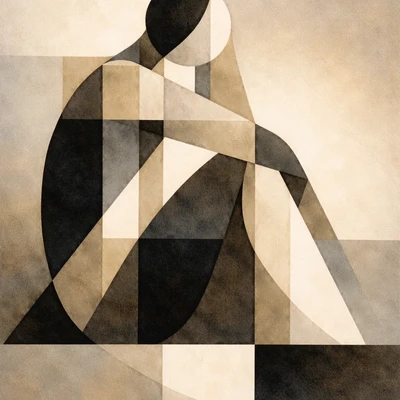
"An abstract maritime composition inspired by Cavafy’s Ithaka, structured through layered horizontal planes and contemplative minimalism. Soft overlapping bands suggest continuity of the sea, while subtle diagonal traces evoke passage, encounter, and gradual transformation. Warm ochres, muted golds, and deep Mediterranean blues symbolize
memory and accumulated wisdom. The horizon dissolves into diffused light, avoiding any literal island form—an undefined destination representing meaning rather than arrival. Translucent textures and atmospheric flatness emphasize coexistence over collision, rhythm over turbulence. The composition embodies a poetic, intellectual abstraction
focused on journey over destination. Within the EU Journeys framework, Ithaka becomes a metaphor for European integration: unity shaped through experience, patience, and shared cultural passage. No realistic depth, no text, no symbols, no flags."