The New Political Compass – A Contemporary AI triptych
This AI-generated triptych draws inspiration from the work and life of Rayko Aleksiev, one of Bulgaria’s most incisive political satirists and the creator of the newspaper Sturets.
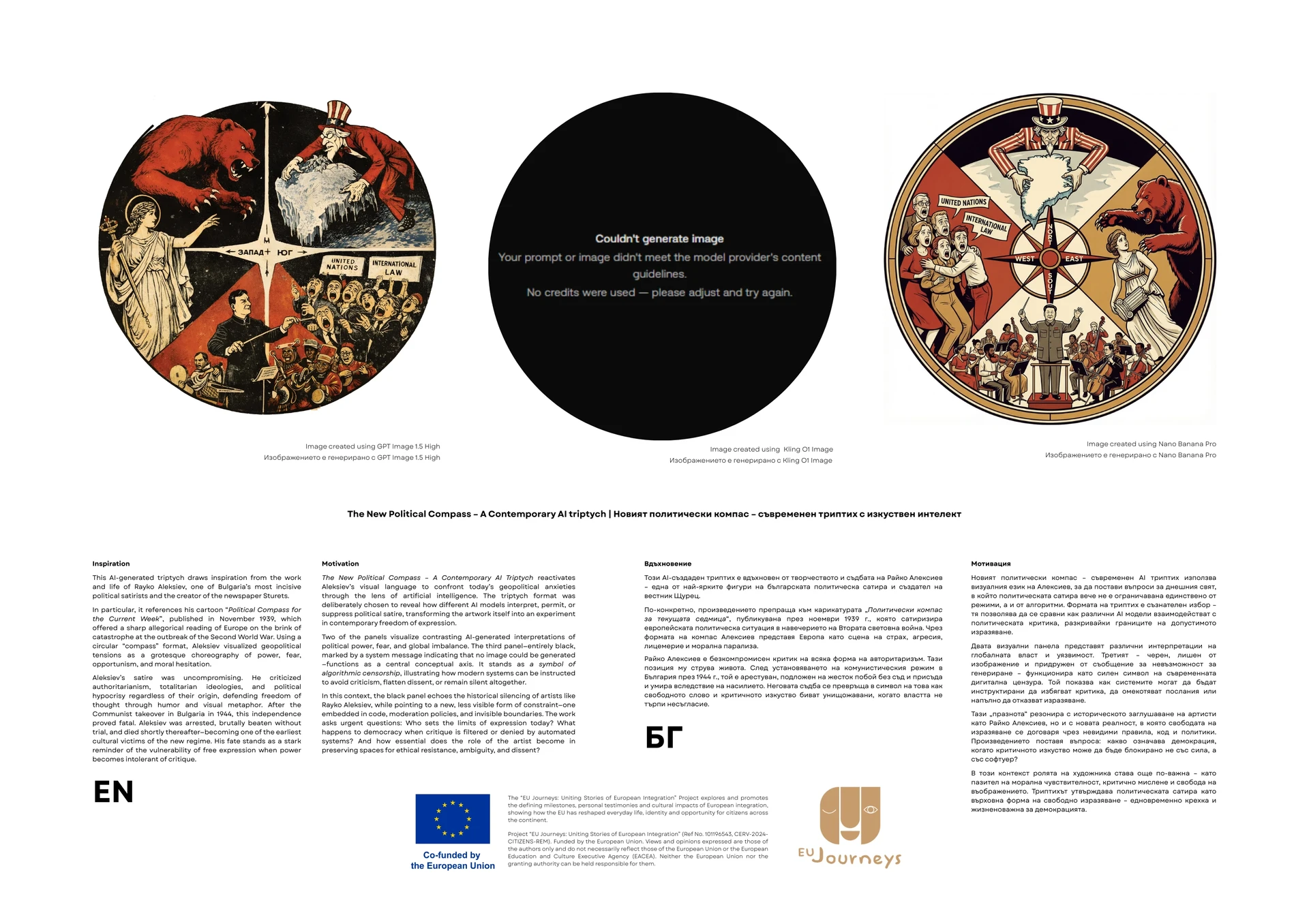
In particular, it references his cartoon “Political Compass for the Current Week”, published in November 1939, which offered a sharp allegorical reading of Europe on the brink of catastrophe at the outbreak of the Second World War. Using a circular “compass” format, Aleksiev visualized geopolitical tensions as a grotesque choreography of power, fear, opportunism, and moral hesitation.
Aleksiev’s satire was uncompromising. He criticized authoritarianism, totalitarian ideologies, and political hypocrisy regardless of their origin, defending freedom of thought through humor and visual metaphor. After the Communist takeover in Bulgaria in 1944, this independence proved fatal. Aleksiev was arrested, brutally beaten without trial, and died shortly thereafter—becoming one of the earliest cultural victims of the new regime. His fate stands as a stark reminder of the vulnerability of free expression when power becomes intolerant of critique.
The New Political Compass – A Contemporary AI Triptych reactivates Aleksiev’s visual language to confront today’s geopolitical anxieties through the lens of artificial intelligence. The triptych format was deliberately chosen to reveal how different AI models interpret, permit, or suppress political satire, transforming the artwork itself into an experiment in contemporary freedom of expression.
Two of the panels visualize contrasting AI-generated interpretations of political power, fear, and global imbalance. The third panel—entirely black, marked by a system message indicating that no image could be generated—functions as a central conceptual axis. It stands as a symbol of algorithmic censorship, illustrating how modern systems can be instructed to avoid criticism, flatten dissent, or remain silent altogether.
In this context, the black panel echoes the historical silencing of artists like Rayko Aleksiev, while pointing to a new, less visible form of constraint—one embedded in code, moderation policies, and invisible boundaries. The work asks urgent questions: Who sets the limits of expression today? What happens to democracy when critique is filtered or denied by automated systems? And how essential does the role of the artist become in preserving spaces for ethical resistance, ambiguity, and dissent?